
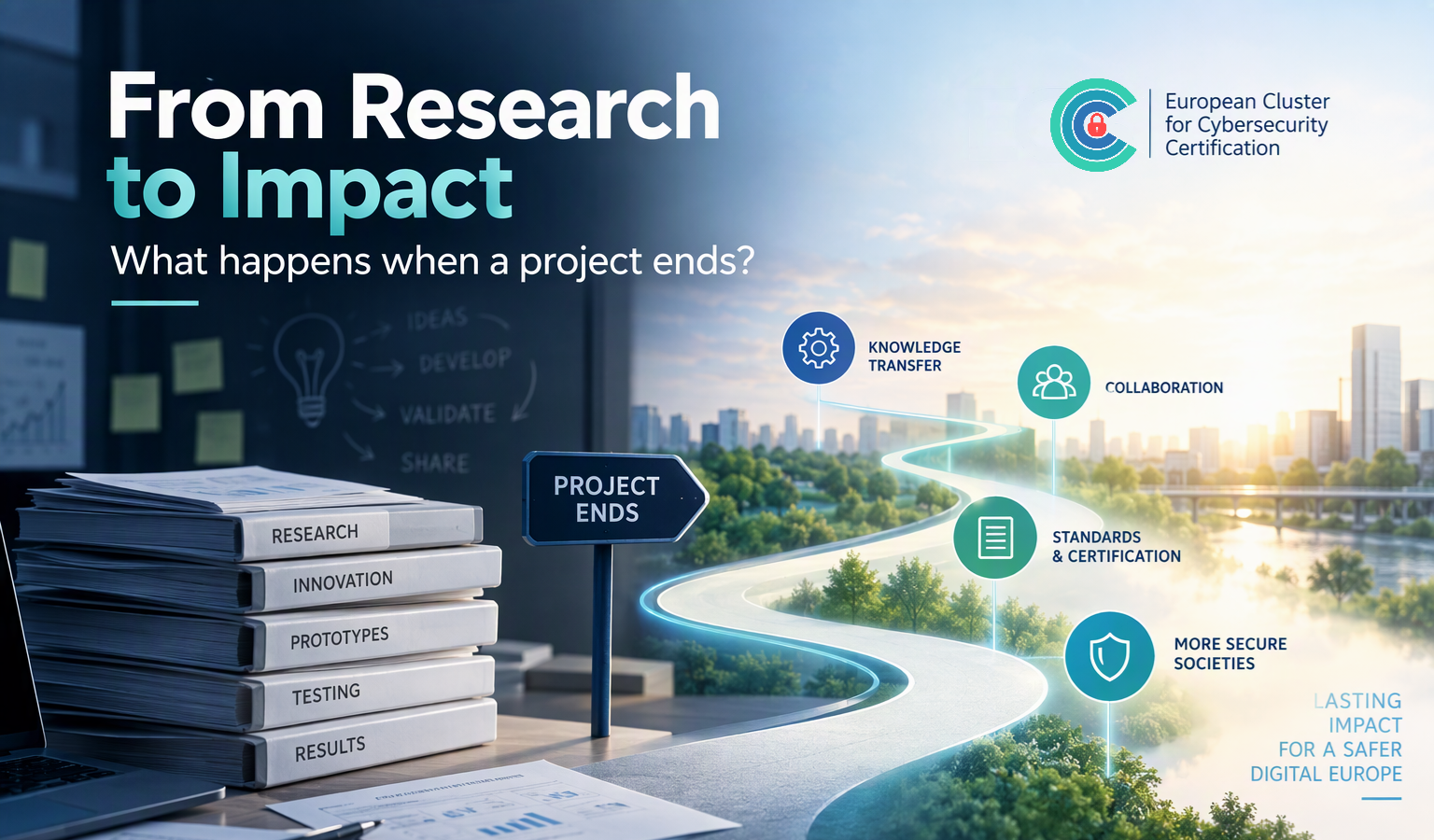
The end of a European research project should not be the end of its results. It should be the beginning of their journey towards real-world impact.
When the funding ends, the real challenge begins
European research and innovation projects bring together organisations, expertise and resources to address complex challenges. Over several years, partners develop technologies, test new approaches and create knowledge that would be difficult to achieve independently.
But what happens when the project ends?
Funding stops and project activities are completed, but the results can continue to create value.
The real challenge is ensuring that technologies and knowledge do not remain confined to deliverables, prototypes or demonstrations. They need to evolve, reach potential users and respond to real needs.
This is where exploitation becomes essential: transforming research results into opportunities for adoption, further development and collaboration.
For EC3 projects, sustainability after the project ends is not about keeping results in place; it is about making sure they keep moving, into new applications, partnerships, and opportunities that the project itself could not have foreseen.
Following we have two examples of the sustainability and exploitation strategy of two of the EC3 cluster projects:
TELEMETRY: turning cybersecurity research into opportunities
The European cybersecurity project TELEMETRY offers a good example.
During the project, partners developed different cybersecurity capabilities in areas such as threat detection, monitoring, risk assessment and security testing. These Key Exploitable Results (KERs) have different levels of maturity and potential applications.
But technical performance alone does not determine their future value.
A technology can become more valuable when it addresses a clear user need, complements existing solutions or is combined with other research results.
The key question therefore becomes:
How can we move from individual research results to solutions that address real-world cybersecurity challenges?
This requires looking beyond the technology itself and considering its maturity, potential users, sustainability and opportunities for collaboration.
The value of collaboration
One of the lessons emerging from TELEMETRY is that exploitation does not necessarily mean bringing every result to market independently.
Cybersecurity challenges are increasingly complex, and different technologies often address different parts of the same problem. Combining complementary capabilities can therefore create new opportunities.
Risk assessment, anomaly detection, monitoring, security testing, for example, can be explored together to address broader cybersecurity needs.
The objective is not necessarily to create a single product. It is to identify where technologies, expertise and organisations can create greater value by working together.
This collaborative approach can also extend beyond the original consortium. Exchanges with other research initiatives, technology providers, industrial stakeholders and potential users can reveal new needs, identify complementarities and open the way to pilots, demonstrators, new research projects or future funding opportunities.
Sustaining collaboration through the DOSS Association
The DOSS project has taken a concrete step towards ensuring the continuity of its results by establishing the DOSS Association. The Association aims to preserve and curate the project’s joint achievements, maintain collaboration among consortium partners and support further dissemination and exploitation beyond the funded project period.
Acting as a common point of contact, the Association will represent the partners’ collective interests and identify new opportunities for further development, collaboration and exploitation. Relevant opportunities, whether involving industrial stakeholders, new research initiatives, pilot activities or potential funding, can be channeled to the partners best positioned to pursue them.
The Association will also ensure the continued visibility and accessibility of the project’s results. It will maintain the DOSS website, manage its YouTube channel and support ongoing communication activities. As new developments and related results emerge, it may also generate and publish additional content, keeping the project’s achievements relevant to the wider cybersecurity community.
Rather than acting as a commercial entity responsible for exploiting individual results, the DOSS Association provides a framework for continuity, coordination and opportunity development. It helps preserve the value of the collaboration established during the project and creates opportunities for partners to build on their achievements, individually or jointly, long after the original funding has ended.
From potential to action
Research results do not automatically become sustainable solutions when a project ends. Moving from potential to impact requires concrete steps.
For some results, the next step may be integration into an existing product or service. Others may require further research, validation or a new pilot. In other cases, the best route forward may be knowledge transfer, open-source development or collaboration within a new research initiative.
There is no single exploitation path.
What matters is turning promising opportunities into action, whether through a joint demonstrator, engagement with potential users, further technology development or a new collaborative project.
And this journey should start before the project ends. Considering exploitation early helps partners understand what is needed for a result to continue developing once the original project framework is no longer there.
The project ends. The opportunity does not.
The end of a funded project is not the end of innovation. It is a transition.
The technologies, knowledge and relationships created during a project can become the foundation for something new. In EC3 cluster projects, this transition is where the real work begins: results become shared assets that open the door to new collaborations and follow-on innovation beyond the boundaries of any single project.
TELEMETRY shows why exploitation is more than a reporting requirement. It is a way to connect research with real needs, technologies with opportunities, and project results with future innovation.
The next step does not have to be a market-ready product. It can start with a new collaboration, a pilot, a joint experiment or a new project bringing complementary expertise together.
Because the real value of research is not only what a project achieves, but what its results make possible afterwards.
From research to impact: the project may end, but the opportunity to create value continues.
[ma1]Input by DOSS
